

Sleep is really important for health and well-being, as well as academic success. However, we often struggle to encourage our teens to get enough sleep…and then, with too many late nights, often struggle to get them out of bed. It can be a vicious circle.
In this blog, Dr Lindsay Browning explores why sleep is different through the teenage years and some important elements to consider when discussing sleep with your teen.
Frequently Asked Questions about Teen Sleep
How much sleep does my teen need?
The recommendations around how much sleep a teenager needs does vary throughout the teen years.
It is recommended that:
- 6 to 13-year-old need 9 to 11 hours of sleep
- 14 to 17-year-olds need 8-10 hours of sleep
- 18+ year-olds need 7 to 9 hours of sleep
When should my teen sleep?
You may notice that your teen is tired because they seem to want to go to bed later…and yet, still have to be up in time for school or college. This means it can be harder to get the recommended amount of sleep.
Our circadian rhythm helps to regulate when people sleep (see figure below), but the problem for teens is that they tend to experience a shift to a later sleep wake cycle, meaning that many teens biologically start to want to go to sleep later and wake up later.
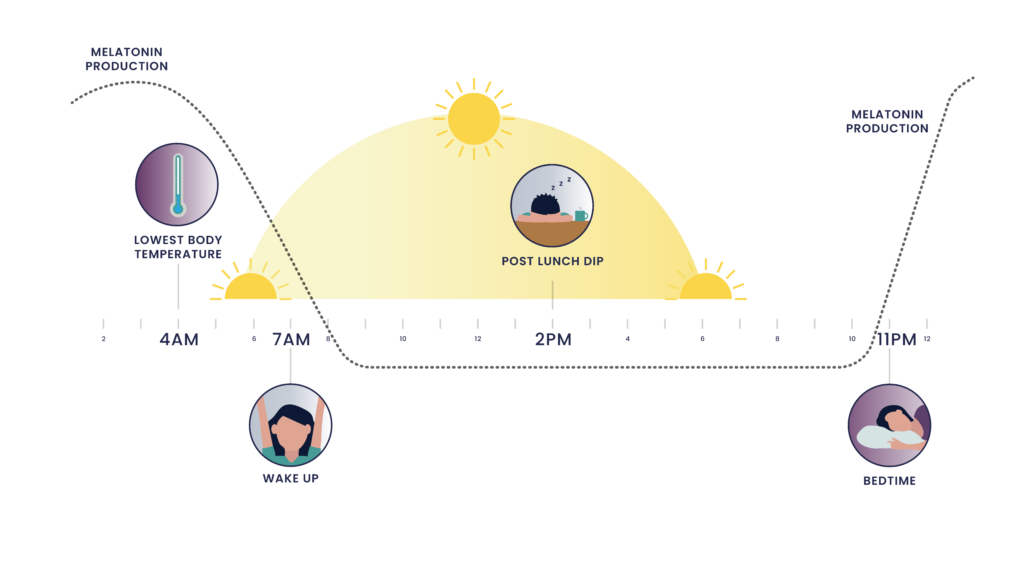
Evolutionarily, we believe that this may be something that evolved so that teenagers could carve out some time late in the evening when adults were asleep, so that they could make friends and start discovering their own personalities, without the grown-ups around.
The difficulty with this preference for going to bed later and waking up later is that it doesn’t work with traditional school and college start times.
Generally speaking, school still starts at the same time each morning and children need to be awake earlier than they want to get up to go to school. However, if they are going to bed at 1am or 2am in the morning and then getting up at 7am, there is no way they will get the required amount of sleep.
Aren’t teens just lazy??
Teens aren’t lazy. This shift to a later sleep cycle, which is a biological fact that happens for many (but not all) teens, can make it seem like they want to ‘sleep all of the time’.
In fact, they are probably just trying to catch up with sleep still required, having gone to bed late but woken early.
However be aware that when teenagers are allowed to sleep in at the weekends very late, this can mean that their circadian rhythm stays at this ‘late preference’. Just like with jetlag, if you get used to going to bed at 2am, then it is very difficult to switch to going to bed at 10pm or 11pm, just because you want to be up in time for school. It’s not easy to shift your bed/wake time by several hours, across different days, just as we experience in a new time zone.
Other sleep issues facing teens
The circadian shift is only one issue facing teenagers.
Stresses and influences
Teenager sleeping issues may be caused a number of factors, including:
- anxiety and stress – with school pressures, as well as around assessments and exams, especially
- substance abuse – such as trying alcohol, vaping and caffeine
- hormonal influences – going through puberty and hormones starting to change
- social pressure – peers encouraging staying up late, use of social media at night, etc.
Lack of light exposure
As light exposure is vital for regulating our circadian rhythm, the tendency for teenagers to not go physically outside and get natural daylight (and instead spend a lot longer in front of screens) may not help with good sleep routines.
Therefore, encouraging teenagers to get outside as much as possible during the day, and especially getting bright sunshine exposure first thing in the morning is vital. The very least you should do is open their curtains soon after waking…I always joke in my talks that this is a big problem for teenage boys!
Physically going outside is really, really important for helping teens feel more awake during the day and sleeping better at night. The early morning light helps the circadian rhythm to stay earlier – keeping them from naturally being drawn to going to sleep and waking up too late.
Sleep and academic success
Sleep is vital for doing well in exams. Sleep consolidates learning. Non-REM sleep has been found to play a crucial role in consolidating declarative memories, which involve recalling information. REM sleep appears to be more significant in supporting procedural or task-based memories.
This means ‘pulling an all nighter’ to cram for an exam or test is a really bad idea. Please let your teen know this!
After 17-19 hours awake, your performance will be the same as a 0.05% alcohol concentration (which is the equivalent of two standard drinks) . You would never drink a double shot of vodka before sitting an exam and yet staying up all night to revise will have a similar consequence.
Also, if you don’t get enough sleep, then you’ll have impaired cognitive function and reduced logical thinking skills.
Sleep and sport
Sleep is also important for sport, as sleep is when our bodies rest and repair. I know a lot of teenagers who really enjoy their sports, either at school or as part of a local team.
Increased sleeping time before a sporting event improves both time accuracy and stamina. Plus, increased sleep after a sporting event helps with muscle repair and learning consolidation.
A conversation around this with your sport-mad teen may help to encourage them to get the sleep they need.
Supporting your teen and their sleep
The teen years can be complicated enough without adding an excessive lack of sleep to the mix. However, as mentioned above it may not be as simple as just encouraging teenage children to ‘get more sleep’ or ‘go to bed earlier’.
Importantly, if exam and school stress or anxiety is affecting a teen, then sleep can be adversely affected.
If you are worried about your teen and want support with their sleep, especially in preparation for exams or before it adversely affects academic performance or their mental health, do get in touch.