
Cancer is a very scary word. It is the diagnosis many fear, especially if we have a family history of cancers or we have experienced a loved one undergoing cancer treatment. If you are diagnosed with cancer, there can feel like there is a lot to learn and to understand. Sleep is commonly affected, for a whole range of reasons. This may not be something you even think about before or when you are first diagnosed. Therefore, it feels important to educate people so that they are aware of how normal this is.
In this blog, Dr Lindsay Browning offers some research findings regarding cancer and sleep, and also some straightforward advice on what to do if your sleep is being negatively affected due to anxiety, pain or some other side effect of your cancer and its treatment.
The research about sleep and cancer
Sleep and cancer have a complex relationship.
Between 30% and 50% of patients with cancer report sleeping difficulties (Garland et al., 2022). Poor sleep is often associated with a number of physical and mental health issues, and, of course, a link between poor sleep and cancer can put increased stress on our perceived need to sleep, as well as causing huge anxiety if we do get a cancer diagnosis. That is, we may start to worry about needing to get good sleep to avoid getting cancer, and if we do get cancer, we may worry that we need to sleep even better to help us fight it.
There are many studies looking at a link between poor and disrupted sleep and cancer. Research findings are mixed. Although some studies have found an association between poor and disrupted sleep and an increased risk of certain types of cancer (Jiang, Y., Gu, X., Yang, X. et al., 2024), that doesn’t mean that poor sleep definitely causes cancer. Interestingly, a large 2018 metanalysis concluded that there wasn’t convincing evidence to say that short sleep increases overall cancer risk (Chen Y, Tan F, Wei L, Li X, Lyu Z, Feng X, Wen Y, Guo L, He J, Dai M, Li N., 2018).
Circadian disruption and cancer
One finding that emerged more consistently was to do with circadian disruption and an increased risk of cancer. That is, people who worked night shifts over a long time period may be at an increased risk of developing cancer.
Shiftwork involving circadian disruption has been classified by the International Agency for Research on Cancer (IARC) as probably carcinogenic to humans (IARC, 2020). Also, sleep and the immune system are closely linked – since sleep is when the immune system is regulated (Besedovsky L, Lange T, Haack M., 2019). Researchers are looking at links between sleep and the body’s ability to recognise and respond to abnormal cell growth, such as in cancer and tumours.
Cancer treatment and sleep
Naturally, if someone has a cancer diagnosis, they want to do everything in their power to maximise their chances of fighting and recovering from the disease. This would include doing things to improve their immune system and, therefore, naturally many people actively want to improve their sleep at this time.
Unfortunately, the stress and anxiety associated with developing cancer can make sleep more challenging. Added to this fact is that cancer treatments, such as chemotherapy, radiotherapy, hormone therapy and even surgery, can all contribute to poor sleep.
There are a number of ways that cancer treatment can affect sleep. Firstly, some studies suggest that chemotherapy may be particularly disruptive to the circadian rhythm by impairing nighttime melatonin secretion (Wentao Li, et al., 2019). Pain and discomfort associated with surgery can obviously interfere with sleep too. In addition, hormone treatment can cause hot flashes and night sweats.
Further, some cancer treatments can cause daytime fatigue, meaning that people spend longer in bed resting during the day which can weaken the body’s drive for sleep at night.
If someone’s sleep begins to deteriorate, but they know that it’s especially important during illness, then this increased focus on sleep and the increased pressure and anxiety about the need to sleep well can paradoxically cause insomnia. The worsening sleep can then lead to increased anxiety leading to a vicious cycle of deteriorating sleep and increasing anxiety.
How to minimise sleep disruption
If you are experiencing cancer and are worried about your sleep, firstly, remind yourself that sleep disruption is very common and understandable at this time.
The increased anxiety about cancer, as well as complications of treatment, are naturally going to affect your sleep. Although there may be a link between poor sleep and increased risk of developing cancer, the link is not conclusive.
Making your sleep as good as it can be at a difficult time
Instead of worrying about something you cannot control, try to do some things to help your sleep be as good as it can be.
- Keep a regular wake time every morning to help stabilise your circadian rhythm.
- Try to minimise long daytime naps as they might take away your sleep drive at night.
- If you do want to nap, then try to keep the nap earlier in the day rather than closer to bedtime, again to avoid any impact on your nighttime sleep.
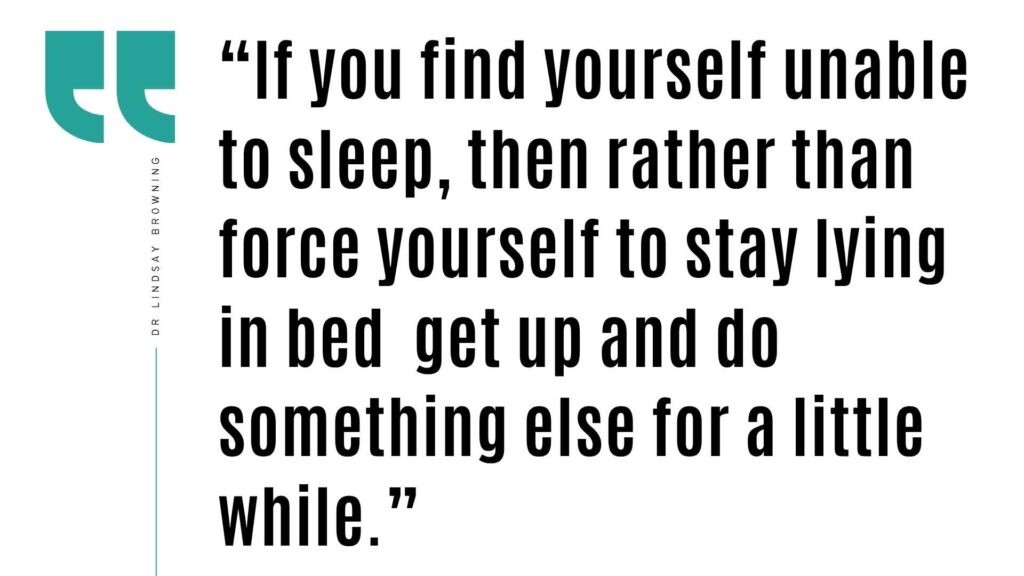
If you find yourself unable to sleep, then rather than force yourself to stay lying in bed becoming increasingly frustrated about your lack of sleep, get up and do something else for a little while. This can help to calm down and break the cycle of frustration. Then, when you return to bed you’re more likely to be able to fall asleep more easily.
Pain management
Ensure that any pain you are experiencing is being managed through pain medication or appropriate comfort levels during the night. You may need to use additional pillows to keep your body propped in a more comfortable position. You may want to use layers in your bedding, so that if you become too hot, you can remove some layers. You could even use two single duvets if you have a shared bed so that you can easily throw off your cover if you get too hot or put it back on if you get too cool, without disturbing your bed partner.
Reach out for help
If your poor sleep is becoming an issue and you’re becoming concerned about it, then CBT-I (cognitive behavioural therapy for insomnia) is the treatment with the strongest evidence base to help overcome insomnia (Johnson JA, et al., 2016).
If you are experiencing cancer, then struggling to sleep can feel especially frightening as it can create worries about your ability to recover and cope with the treatment. However, remember that sleeping problems are common and understandable, but they are treatable. With appropriate support and treatment your sleep can often improve helping you to feel more able to cope during cancer treatment and beyond. Do reach out today for further help.
Bibliography
Besedovsky L, Lange T, Haack M. (2019). The Sleep-Immune Crosstalk in Health and Disease. Physiological Reviews, 1325-1380, https://journals.physiology.org/doi/full/10.1152/physrev.00010.2018
Chen Y, Tan F, Wei L, Li X, Lyu Z, Feng X, Wen Y, Guo L, He J, Dai M, Li N. (2018). Sleep duration and the risk of cancer: a systematic review and meta-analysis including dose-response relationship. BMC Cancer(18(1)), 1149, https://link.springer.com/article/10.1186/s12885-018-5025-y
Garland SN, Z. E.-I. (2022). Sleep and Cancer across the Life Span. In R. T. Kryger MH, Kryger’s Principles and Practice of Sleep Medicine. 7th ed. (p. Chapter 153). Philadelphia: Elsevier.
IARC. (2020). IARC Monographs on the Identification of Carcinogenic Hazards to Humans Volume 124. p. https://www.ncbi.nlm.nih.gov/books/NBK568195/pdf/Bookshelf_NBK568195.pdf
Jiang, Y., Gu, X., Yang, X. et al. (2024). Exploring the association between sleep duration and cancer risk in middle-aged and older Chinese adults: observations from a representative cohort study (2011–2020). BMC Public Health(24), 1819, https://doi.org/10.1186/s12889-024-19313-z
Johnson JA, Rash JA, Campbell TS, Savard J, Gehrman PR, Perlis M, Carlson LE, Garland SN. (2016). A systematic review and meta-analysis of randomized controlled trials of cognitive behavior therapy for insomnia (CBT-I) in cancer survivors. Sleep Medicine Reviews, 20-28, https://pubmed.ncbi.nlm.nih.gov/26434673/
Wentao Li, Carol Chi-Hei Kwok, Dominic Chun-Wan Chan, Amy Wing-Yin Ho, Chung-Shun Ho, Jihui Zhang, Yun Kwok Wing, Feng Wang, Lap Ah Tse. (2019). Disruption of sleep, sleep-wake activity rhythm, and nocturnal melatonin production in breast cancer patients undergoing adjuvant chemotherapy: prospective cohort study. Sleep Medicine, 55, 14-21, https://doi.org/10.1016/j.sleep.2018.11.022