
When thinking about our weight management, we often think about our diet, lifestyle choices and exercise, but, have you ever considered if your sleep is having an effect?
In this blog, Dr Lindsay Browning explores the research around sleep, weight loss, weight gain and our food cravings.
Understanding the link between sleep and weight
What role does sleep play in weight gain or loss?
When people are trying to manage their weight, they often exclusively focus on things like diet and exercise. They may not realise that sleep plays an important role in it too, in many different ways. Read on to find out more.
What evidence is there that links sleep and weight?
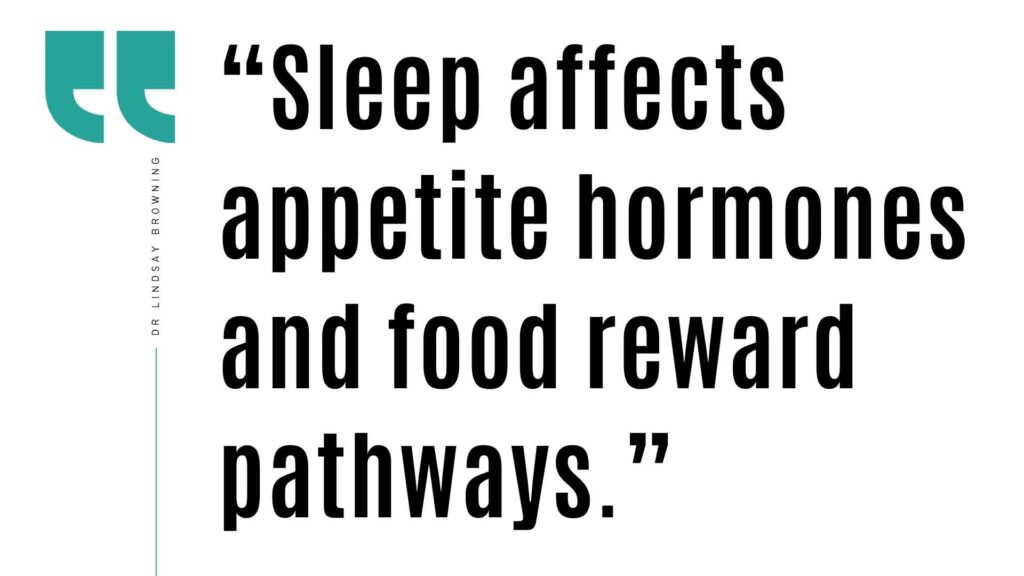
Many studies have found a link between not getting enough sleep (i.e. less than 7 hours on average) and increased weight, compared to people getting enough sleep (7-9 hours sleep). This relationship may be explained by changes in hormones that regulate appetite.
During sleep, our body regulates hormones that control hunger and satiation (fullness). These hormones are ghrelin and leptin. Several studies, including one in 2020 by Lin et al, have found that when people don’t get enough sleep, levels of the hunger hormone (called ghrelin) tend to rise. This means that people who sleep less feel more hungry than those who have slept more and feel they have had a good night’s sleep.
Similarly, after a night of sleep deprivation, several studies (see van Egmond et al 2023) have found that the hormone levels for satiation (leptin) are reduced, meaning people may need to eat more food to feel satisfied.
Can lack of sleep cause weight gain?
Some studies have found that when people were sleep deprived (around 3.5-5 hours’ sleep) they tended to eat on average an additional 385 calories, compared to people getting enough sleep (typically 7 to 9 hours), as described in Khatib et al (2017).
In addition, the foods that ‘short sleepers’ tended to choose were different from people who were well rested.
Does sleep affect what we choose to eat?
Research suggests that those who have had little sleep tend to choose higher carbohydrate and higher fat foods (especially those high in saturated fat), as identified in St-Onge et al (2011).
Interestingly, people’s emotional reaction to foods may also be affected by sleep loss. Some studies have found that people who are sleep deprived rate high-calorie food, such as sweets and junk food, as more appealing (see Greer et al (2013)) .
Lack of sleep may also affect desire for snacking, even when not hungry, by affecting the brain’s reward system. One study, Cedernaes et al (2016), found that levels of a chemical messenger involved in reward and food cravings (2-AG) were increased after sleep deprivation – which could help explain why people may be more likely to crave an afternoon or evening snack, when they haven’t slept enough.
Can sleep affect your metabolism?
Sleep seems to affect our metabolism by increasing insulin resistance and cortisol. Sleep deprivation is linked to an increased risk of obesity and diabetes, potentially due to reducing insulin sensitivity, as stated in Broussard et al (2012).
Furthermore , poor sleep may increase cortisol levels (Spiegel et al, 1999). This may encourage increased fat storage, particularly around the tummy area.
Can more sleep help me to lose weight?
For people actively wanting to lose weight, deliberately trying to get additional sleep may be helpful. In an experiment of people who usually didn’t sleep enough, they were asked to deliberately increase their sleep duration (to sleep longer). The researchers, Tasali et al (2022), found that increasing sleep led to a reduced calorie intake by approximately 270 calories per day.
Sleep, food and weight management
In summary, overall, getting a good night’s sleep appears to influence weight in many ways.
When people don’t get enough sleep, they often feel hungrier and may crave more high-fat, high-calorie foods. Plus, they may experience changes in metabolism that make weight management more difficult.
Although the importance of sleep is often overlooked, getting the recommended 7 to 9 hours of sleep each night may help support appetite regulation and help you to make healthier food choices.
While good sleep isn’t a substitute for a healthy diet and regular exercise, it may be an important piece of the puzzle.
If you want to improve your sleep or learn more about food and sleep, go and explore these articles too:
References
Al Khatib HK, Harding SV, Darzi J, Pot GK. The effects of partial sleep deprivation on energy balance: a systematic review and meta-analysis. Eur J Clin Nutr. 2017 May;71(5):614-624. doi: 10.1038/ejcn.2016.201. Epub 2016 Nov 2. PMID: 27804960.
Lin J, Jiang Y, Wang G, Meng M, Zhu Q, Mei H, Liu S, Jiang F. Associations of short sleep duration with appetite-regulating hormones and adipokines: A systematic review and meta-analysis. Obes Rev. 2020 Nov;21(11):e13051. doi: 10.1111/obr.13051. Epub 2020 Jun 15. PMID: 32537891.
van Egmond LT, Meth EMS, Engström J, Ilemosoglou M, Keller JA, Vogel H, Benedict C. Effects of acute sleep loss on leptin, ghrelin, and adiponectin in adults with healthy weight and obesity: A laboratory study. Obesity (Silver Spring). 2023 Mar;31(3):635-641. doi: 10.1002/oby.23616. Epub 2022 Nov 20. PMID: 36404495.
Greer SM, Goldstein AN, Walker MP. The impact of sleep deprivation on food desire in the human brain. Nat Commun. 2013;4:2259. doi: 10.1038/ncomms3259. PMID: 23922121; PMCID: PMC3763921.
St-Onge MP, Roberts AL, Chen J, Kelleman M, O’Keeffe M, RoyChoudhury A, Jones PJ. Short sleep duration increases energy intakes but does not change energy expenditure in normal-weight individuals. Am J Clin Nutr. 2011 Aug;94(2):410-6. doi: 10.3945/ajcn.111.013904. Epub 2011 Jun 29. PMID: 21715510; PMCID: PMC3142720.
Cedernaes J, Fanelli F, Fazzini A, Pagotto U, Broman JE, Vogel H, Dickson SL, Schiöth HB, Benedict C. Sleep restriction alters plasma endocannabinoids concentrations before but not after exercise in humans. Psychoneuroendocrinology. 2016 Dec;74:258-268. doi: 10.1016/j.psyneuen.2016.09.014. Epub 2016 Sep 22. PMID: 27689899.
Tasali E, Wroblewski K, Kahn E, Kilkus J, Schoeller DA. Effect of Sleep Extension on Objectively Assessed Energy Intake Among Adults With Overweight in Real-life Settings: A Randomized Clinical Trial. JAMA Intern Med. 2022 Apr 1;182(4):365-374. doi: 10.1001/jamainternmed.2021.8098. PMID: 35129580; PMCID: PMC8822469.
Broussard JL, Ehrmann DA, Van Cauter E, Tasali E, Brady MJ. Impaired insulin signaling in human adipocytes after experimental sleep restriction: a randomized, crossover study. Ann Intern Med. 2012 Oct 16;157(8):549-57. doi: 10.7326/0003-4819-157-8-201210160-00005. PMID: 23070488; PMCID: PMC4435718.
Spiegel K, Leproult R, Van Cauter E. Impact of sleep debt on metabolic and endocrine function. Lancet. 1999 Oct 23;354(9188):1435-9. doi: 10.1016/S0140-6736(99)01376-8. PMID: 10543671.