
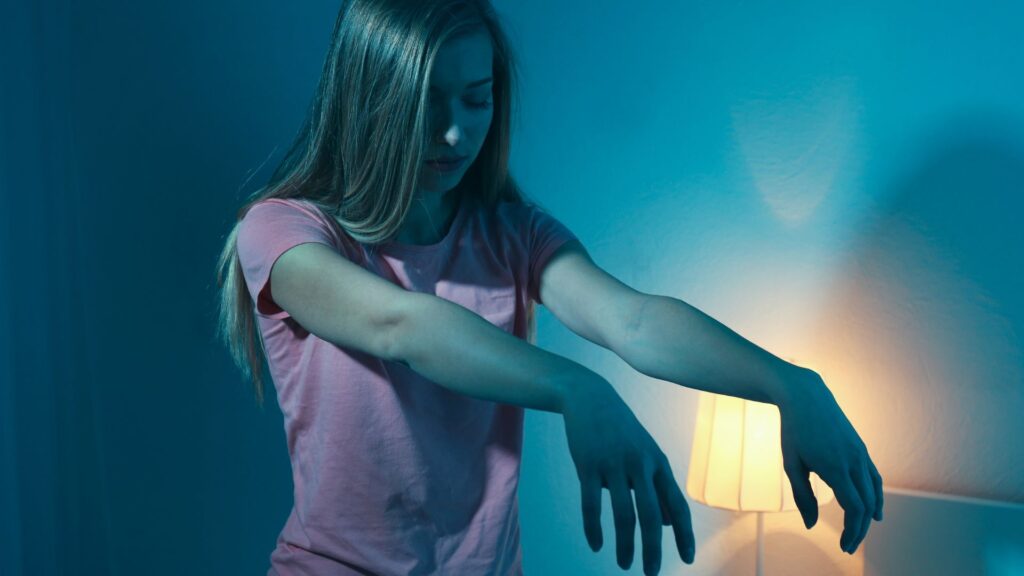
Parasomnias can be scary to witness or to be told about after the event. Therefore, it is important to understand what they are and how they happen.
In this blog, Dr Lindsay Browning explains what parasomnias are, including the different types, such as sleep walking, sleep talking, night terrors and sleep paralysis. She also explore what may cause them and how to try to stop them happening.
What are parasomnias?
Parasomnias are sleep disorders where someone experiences an undesirable behaviour (such as moving, walking or talking) or a sensory experience (such as dreaming or hallucinations) during sleep.
These events tend to happen when falling asleep, during, or waking from sleep. Most parasomnias are a mixed state between sleep and wakefulness, where the person is both partially asleep and partially awake at the same time.
Parasomnias can be categorised as non-rapid eye movement (NREM) parasomnias or rapid eye movement (REM) parasomnias, depending on which part of sleep they occur. NREM parasomnias typically occur in the first third of the night, whereas REM parasomnias tend to occur in the latter half of the night. Plus, there is another category called “other parasomnias”, which covers parasomnias that do not fit neatly into either the REM or NREM classifications.
Why types of night time activities are classed as parasomnias?
Sleepwalking (somnambulism)
Sleepwalking (or officially called, somnambulism) is an NREM parasomnia, which involves the person walking or performing other physical actions, while still in NREM sleep.
Someone who is sleepwalking is not fully conscious, but they may open their eyes, get up out of bed, walk downstairs, open the fridge and even eat something …and then, go back to bed again. However, they will have been asleep the whole time and often have no memory of it the next morning.
Although sleepwalking may seem harmless, it can cause problems if somebody might do something dangerous, such as climbing out of a window or falling down the stairs, because they are not fully awake and aware of what’s really going on.
Sleeptalking (somniloquy)
Sleeptalking (or somniloquy) is a parasomnia where someone may start talking, mumbling, or shouting during their sleep without being aware that they’re doing so. It can occur in any sleep stage but is most common in NREM sleep.
Night terrors
Night terrors are a parasomnia and are distinct from nightmares because they do not occur during REM sleep and don’t involve a scary plot. The person experiencing a night terror will appear to wake from sleep, sit up or jump up screaming and appear terrified, but they will not be awake. If someone tries to comfort them, the person experiencing the night terror will be unresponsive to those around them. Unlike with a nightmare, the person experiencing the night terror will most likely not remember it having happened the next morning. Night terrors are more common in children than adults.
Since night terrors are a sleep/wake confusion, they are more likely to occur when someone’s sleep is disturbed, such as by sleep apnoea.
Bed wetting (sleep enuresis)
Bed wetting, or sleep enuresis, is an example of an “other parasomnia”. It is when somebody urinates (wees) during their sleep, typically in the bed itself. It is a parasomnia because the person is not aware that they are going to the toilet as they are still asleep when it happens. They have no awareness or control over it at the time.
Sleep paralysis
Sleep paralysis occurs when somebody partially wakes from REM sleep and finds themselves conscious in bed, but paralysed and unable to move. As they are still partially stuck in a dream state, they will often have hallucinations and typically describe seeing an ominous figure at the foot of the bed, or may imagine themselves floating above their own body.
When somebody experiences sleep paralysis, they will often report feeling terrified as they feel trapped inside their body with an evil figure in their bedroom and unable to wake up. There is a scientific explanation for sleep paralysis: when we enter REM sleep our muscles become paralysed (called REM atonia) so that we don’t act out our dreams, however during sleep paralysis the person partially wakes up and is conscious but their body remains paralysed. This is a sleep/wake mismatch as the person has not fully left REM sleep and woken up.
What causes parasomnias?
Most parasomnias occur when somebody partially wakes up from a part of sleep, but remains in a state that is not fully awake, nor fully asleep. There are many different potential causes for this.
Genetics is a very common factor, especially for things like sleepwalking and night terrors, as they tend to run in families. Also, sleepwalking and night terrors are more likely to occur in children compared to adults, as they tend to have deeper NREM sleep.
Sleep deprivation can increase the likelihood of parasomnias as the person is likely to spend longer in NREM sleep, and when any arousals occur they may not lead to fully waking up. Therefore, ensuring somebody regularly gets enough sleep and has good sleep hygiene can make them less likely to occur.
Alcohol can also make parasomnia more likely to happen. As alcohol affects sleep architecture, it can cause more fragmented and disturbed REM sleep in the latter part of the night, increasing the likelihood of parasomnias to occur.
Stress or anxiety can also be a cause. If somebody is stressed or anxious, this can also increase the likelihood of parasomnias because the person is more likely to partially wake up from within sleep.
Finally, sleep disorders, such as sleep apnoea or periodic limb movement disorder, can make parasomnias more likely to happen because they cause the person to wake up from within sleep. This kind of disruption to the natural sleep cycles can lead to someone only partially waking up from sleep (not being fully awake, nor fully asleep).
What can help to stop a parasomnia?
With the exception of bedwetting, which may be a medical issue and require speaking to a medical professional (urologist) for bladder training or using an enuresis alarm, the majority of parasomnias may be improved (though not necessarily stopped altogether) by focusing on getting enough good quality sleep each night and ensuring good sleep hygiene practices of relaxation before bed and avoiding caffeine and alcohol close to bedtime.
For people who experience sleepwalking, it is especially important to make the sleeping environment as safe as possible by removing obstacles that could be dangerous in the night (sharp objects and trip hazards) and locking doors and windows to prevent the person leaving the bedroom, or house.
Night terrors can sometimes be improved by deliberately waking the person up for a few nights around 15 minutes before the usual time of their night terror, which can sometimes help to prevent the night terror from happening.
Sleep paralysis can sometimes be related to another sleep disorder such as narcolepsy or sleep apnoea so ruling out or treating any comorbid conditions can help reduce the frequency of the parasomnias.
CBT for anxiety can help reduce stress-induced parasomnias, and CBT-I can improve those linked to poor sleep quality or sleep deprivation.
Getting help if you are suffering with a parasomnia
If from the list above, you feel CBT-I and sleep therapy could help you, your bed partner or child, then do get in touch.
Our team of therapists are ready to help and can guide you to the right kind of support, simply from an initial consultation.