Learn more about the sleep expert and how Dr Lindsay Browning can help you.
BSc MSc DPhil (Oxon) CPsychol AFBPsS
Trouble Sleeping was founded in 2006, by Dr Lindsay Browning, to help people with their sleep.
Dr Browning is a chartered psychologist, neuroscientist, experienced speaker and author, who holds a doctorate in insomnia from the University of Oxford, UK.
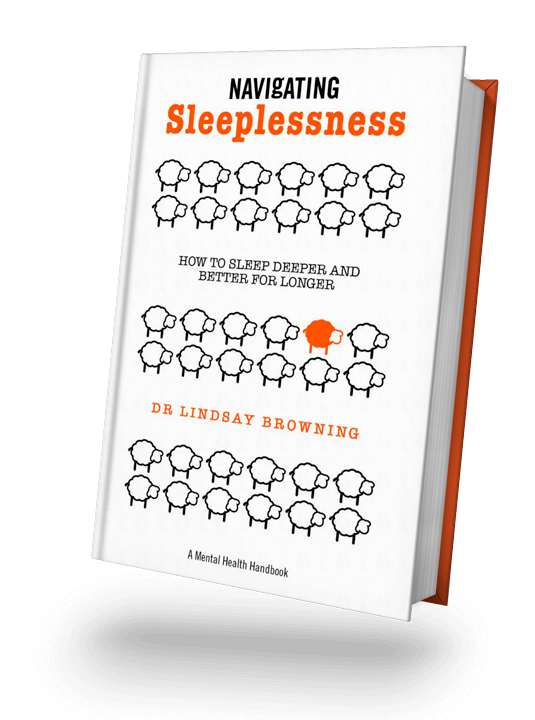
She is a qualified sleep expert offering therapy based on cognitive behavioural therapy for insomnia (CBT-I). Her book, Navigating Sleeplessness, is a trusted resource that has supported many with their sleep issues and concerns.
Available from major booksellers
If you are struggling with sleep, then buy this book.
Navigating Sleeplessness helps you to learn to understand your patterns and discover what works, so that you can build and maintain a healthy personal sleep plan.
You will find actionable strategies and step-by-step solutions to develop better sleep, using self-care and self-compassion.
You will discover how to:
Buy this book today and start sleeping better tonight
































Insomnia (https://troublesleeping.co.uk/what-is-insomnia/) is a sleep condition. It means you have trouble falling asleep, staying asleep or waking up too early and being unable to get back to sleep again, on a regular basis. It is a sleep issue that is affecting more and more people and if left untreated can cause more serious physical and mental health issues.
Sleep trackers can sometimes provide helpful feedback about our patterns of sleep but the sleep data may not be as reliable and accurate as you think, especially about particular sleep stages. Learn more here: https://troublesleeping.co.uk/sleep-patterns/
How you actually feel about your sleep is often a better indication of how you’re sleeping, than a “sleep score”, from a sleep tracker. It is important to be aware of ‘orthosomnia’, a condition where one can become obsessed with getting “perfect sleep”. Rely on how you feel and practice good sleep hygiene (link: https://troublesleeping.co.uk/sleep-hygiene/ ) to help ensure high quality, as well as a good quantity, of sleep.
I do not offer sleep apnoea treatment or diagnosis.
Sleep apnoea (link: https://www.nhs.uk/conditions/sleep-apnoea/) is a commonly underdiagnosed disorder. It is a condition where your breathing stops and starts, while you sleep. It is different to just having broken nights of sleep and waking in the middle of the night. Learn more here: https://troublesleeping.co.uk/broken-sleep/
It can be the case sometimes that people develop insomnia when they have sleep apnoea, which I can help with, but it is important that if you do have this diagnosis that it is investigated and treated first, so do speak to your GP in the first instance.
The exact amount of sleep you require depends on your age and gender, as well as lifestyle, health and other factors. However, as a general rule adults need between 7-9 hours of sleep every night. If you are getting somewhere near the recommended amount of sleep and feeling refreshed throughout the day, then that’s probably the right amount of sleep for you.
Our circadian rhythm is our internal clock, which tells our bodies when to do things, like eat and sleep. Your circadian rhythm is responsible for producing a hormone called melatonin. This hormone regulates sleep. We naturally produce melatonin to help us go to sleep.
Read more here https://troublesleeping.co.uk/understanding-our-circadian-rhythm/
There are lots of things that you can do to help you prepare for a good night’s sleep, both in the day time, the early evening and at night. It often involves having good sleep hygiene techniques. https://troublesleeping.co.uk/sleep-hygiene/ and also ensuring you have a bedroom environment https://troublesleeping.co.uk/category/bedroom-environment/ conducive to good sleep. However, although you can do things before bed to make it more likely that you will sleep well at night, there is nothing you can do to ensure that you fall asleep quickly and stay asleep through the night. Occasionally, we may not have a great night’s sleep despite doing all the right things during the day, and that is ok.
Find 5 top tips for getting a good night’s sleep here: https://troublesleeping.co.uk/getting-a-good-nights-sleep/
Our sessions start from £199 for a 50 minute one-to-one session about improving and optimising your sleep. Our CBT-I packages start from £299
Dreams are a completely natural part of sleep. They are the brain’s way of processing a whole range of scenarios, emotions and experiences. Although everybody dreams during the night, not everyone remembers dreaming because you may not wake up from within a dreaming part of sleep. If you are someone who always remembers dreaming, or you never remember dreaming, don’t worry – both are normal.
However, if you feel your dreams are disruptive or that you are not getting enough complete sleep cycles to allow for sufficient ‘dream time’, you may want to seek support. Learn more about dreams: https://troublesleeping.co.uk/dream-facts-and-faqs/
At Trouble Sleeping, we are advocates for good sleep hygiene (link: https://troublesleeping.co.uk/sleep-hygiene/) and regular good bedtime routines (link https://troublesleeping.co.uk/7-elements-of-a-good-bedtime-routine/) , however, it can be the case that this is not helpful for insomnia. This is because it focuses on doing things to make (or even ‘force’) sleep to happen.
Insomnia can occur when people are trying too hard to sleep and that level of pressure and anxiety about the need to sleep well, paradoxically, means that they don’t sleep.
CBT-I (Link https://troublesleeping.co.uk/what-is-cbt-i/) is very different to good sleep hygiene and if you feel that you’ve tried everything, then this might be what you need at this stage.
There is no truly robust scientific research that backs up the use of supplements to help sleep.
Although things like magnesium can be helpful if you have a magnesium deficiency, there is limited evidence that magnesium supplements will help you sleep if your magnesium levels are already adequate.
CBT-I (Link https://troublesleeping.co.uk/what-is-cbt-i/) really is the gold standard treatment for prolonged sleeping issues.
Yes, you can speak to us for some advice on how to improve your sleep, even if it isn’t bad.
There are always ways of improving.
You can book a sleep audit session to discuss your current sleep and how you can optimise it. The 50 minute session followed by a summary report is £199.
Client feedback